





Find RochesterA guide to housing and place on the Medway

Six chapters, read in order: the market, what moves prices, buying and selling, surveys and searches, money, and the areas themselves.

The areas, one by one

Six parts of one small town, with housing stock so different that they behave almost as separate markets. What follows is character and constraint, not valuation.

Building types you will meet

Each plate stands for a type that recurs across the areas below; the types themselves are treated in reading the houses.


Line drawing of a square Norman keep with corner turrets.
The keepNorman military stone: the fixed point every later street was laid out around.
Line drawing of a church tower with a pitched cap and a flag mast.
The cathedral towerThe precinct that kept a quarter of the old town out of the hands of developers.
Line drawing of a shopfront with a fascia band and a tall window.
Georgian shopfrontFlats over shops: the town centre stock that is easiest to reach and hardest to alter.
Line drawing of two joined terraced houses with pitched roofs.
Victorian terraceBay-fronted two-storey terraces, the ordinary housing of the hill streets.
Line drawing of an apartment block with a regular grid of windows.
Riverside blockApartments on former wharf ground, with service charges and a managed estate.
Line drawing of a pair of semi-detached houses under one roof.
Interwar semiBay windows, side access and a garden: the suburban expansion of the 1930s.
Line drawing of a rectangular block divided into regular dwellings.
Post-war estatePlanned layouts from the rebuilding decades, often with generous open space.
Line drawing of a pitched station canopy over a platform building.
The station canopyThe single strongest influence on where demand concentrates in the town.

The areas


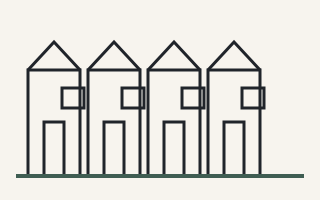
Line drawing of a run of four terraced frontages above a heavy ground rule.

The High Street and the precinct

The oldest continuously occupied part of the town: a long shopping street of mixed frontages, with the cathedral precinct and the castle grounds immediately behind it. Housing here is a patchwork of flats over shops, small courts behind the street line, and a handful of larger houses on the lanes running down to the river. Almost all of it sits inside a conservation area, which shapes what an owner can change and how the street keeps its face.

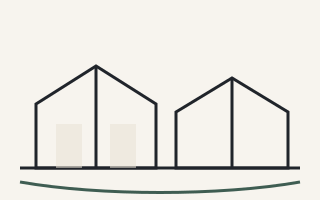
Line drawing of three riverside blocks of differing heights above a ruled water band.

The Esplanade and the riverside

The strip between the castle bank and the water, where the town turns to face the Medway. It mixes older houses that were always addressed to the river with later flats built when industrial frontage came out of use. The attraction is the view and the walk; the questions are flood mapping, wind off the water, and how much of the outlook is protected by what stands opposite.

Line drawing of a terrace of small houses climbing away from a ground rule.

Delce and the hill streets

The dense residential slope inland of the station, mostly late-Victorian and Edwardian terraces laid out street by street as the town grew away from the river. Houses here are the workhorse stock of the town: two-storey, bay-fronted or flat-fronted, small gardens, on-street parking. The gradient matters more than newcomers expect, both for the walk home and for how the streets drain.

Line drawing of two gabled semi-detached houses on a curving road.

Borstal and the western edge

A separate settlement on the hillside upstream, absorbed into the town without ever quite losing its village shape. The stock leans towards interwar and post-war semi-detached houses with proper gardens, on roads that curve rather than grid. It is quieter, greener and further from the station, and it trades convenience for space in a way that shows in every measure of the local market.

Line drawing of new riverside apartment blocks with regular window bays.

Rochester Riverside

Former industrial and wharf land between the station and the water, rebuilt over the last two decades as new housing. It is the one part of the town where the stock is genuinely modern: apartment blocks and terraces of recent construction, laid out to a masterplan rather than accumulated street by street. Buyers get modern building fabric and a short walk to the trains; they also get service charges, estate management and a neighbourhood that is still finishing itself.

Line drawing of a run of post-war houses behind a low ground rule.

The Strood bank

Across the bridge on the west side of the river, closer in feel to the working Medway towns than to the cathedral end. The housing is broader in range and generally cheaper: Victorian terraces near the old centre, interwar ribbons along the main roads, and post-war estates behind them. Its case is the crossing, the station and the price difference; its cost is that the river is between it and the town most people mean when they say Rochester.

How to compare them

The temptation with any area guide is to rank the places. It is a mistake, because the variables people care about pull against each other and different households weigh them differently. Walking distance to the station and quiet both have value; almost nowhere has much of each. A garden and a five-minute walk to the High Street are not usually available in the same house at the same price.

The more useful exercise is to write down, before looking at anything, the two constraints that cannot be traded away — a maximum door-to-door commute, a number of bedrooms, a requirement for off-street parking, a school catchment, a tolerance for stairs — and then find which areas can supply both. In a town this size the answer is usually one or two areas, which makes the rest of the search enormously easier.

Then walk them. An area guide, this one included, cannot tell you what a street sounds like on a weekday evening, how the light falls, where the traffic queues, or whether the walk from the station in the dark is one you want to make twice a day for a decade. Those are the things that decide whether a household is happy where it lands, and they take an afternoon to find out.